Joseph Hans Lazar
Los pacientes del doctor GarcíaJosef Hans Lazar is the Third Reich’s press attaché in Madrid and one of its most effective political operators in wartime Spain. He makes the Spanish press conceal Germany’s defeat at Stalingrad, builds influence through both money and hospitality, and remains in place after the war. When Allied representatives finally enter the German Embassy in June 1945, they find it stripped bare and Lazar calmly claiming the building as his private residence: the sole human remnant of an operation whose material traces have vanished.
Origins and political formation
Born in Istanbul in 1895, Lazar was the son of a diplomat serving at the Austrian embassy to the Ottoman Empire and a mother of Albanian origin, at least partly Jewish. As an adolescent he moved to Austria to continue his education, but the First World War interrupted it. He served in the Austro-Hungarian army, suffered severe wounds, and was left with chronic pain and a lasting morphine addiction.
After returning to civilian life, Lazar became a Bucharest correspondent for the German state news agency Deutsches Nachrichtenbüro in 1927. He married the Romanian aristocrat Baroness Elena Petrino Borkowska in 1937. The following year he moved with her to Berlin to serve as press attaché at the Austrian embassy to Hitler. Austria selected him for his public sympathy toward Nazism, expecting his contacts to help preserve Austrian independence. Instead, from the moment he arrived in Berlin, he worked against that purpose.
Lazar had belonged to Hitler’s party for years, despite a family background that violated the regime’s racial laws. His ancestry brought him no apparent obstacle to advancement. Working from the Austrian embassy under Joseph Goebbels, he became an ardent propagandist for the Anschluss, the annexation of Austria by Germany. After the annexation, he told foreign correspondents in Vienna that the land of his ancestors had become another region of Hitler’s Germany. Following that success, Hitler sent him to Spain, where Lazar would remain for the rest of his life.
Madrid: press control and social influence
In June 1938, Lazar presented himself to the government in Burgos as a correspondent for Transocean, a news agency established to spread the ideals of the new Germany in Spain and Latin America. After Franco’s victory, he became press attaché at the German embassy. Madrid gossip soon gave him more authority than the ambassador, Eberhard von Stohrer, despite the sharp contrast between Lazar’s appearance and the regime’s idealized image of an Aryan diplomat.
Short, stout, and dark-skinned, with a look the narrative describes as Eastern Jewish and a complexion it calls gypsy-like, Lazar nevertheless became a brilliant fixture of Madrid’s social life. Cosmopolitan, multilingual, and highly cultivated, he was known for immaculate dress, a gold monocle over his right eye, imperial manners, and exquisite courtesy. Friends called him Bam. His wit and affability mattered alongside his political craft: the narrative presents him as exceptionally intelligent, quick to understand the workings of the Franco regime, and able to make influential company feel both privileged and close to power.
His wife, Baroness Petrino, whom intimates called Lenta, was a celebrated cook. At the Lazars’ frequent dinners, selected journalists from Madrid newsrooms—poorly paid writers otherwise living obscure lives—ate fine food and drank excellent wine alongside senior Francoist officials and Nazi diplomats. The arrangement offered more than a meal or a discreet payment. It gave journalists a sense of proximity to power and made the couple’s home a social conduit between the press, the regime, and the German diplomatic circle.
Lazar did pay generously to influential journalists, but bribery alone does not explain his success. The narrative stresses that the loyalty secured through the Lazars’ social skills exceeded what money could buy. His methods also protected Berlin from direct attribution: he infiltrated the newly founded EFE news agency to spread Berlin’s views in Latin America and worked through Spanish organizations in ways that left no provable link to the embassy or the German government. Through these channels, he helped create what the book calls the most favorable public opinion for the Axis to be found in a neutral country.
Stalingrad and the management of defeat
On 2 February 1943, Lazar is in Madrid and already knows what the defeat at Stalingrad means. Hitler had promoted Friedrich Paulus to field marshal on 30 January, a gesture understood as an expectation that Paulus would kill himself rather than surrender. Instead, Paulus surrendered to the Soviet Union with what remained of the Sixth Army. The force had lost nearly two hundred thousand men, almost two-thirds of them dead. Lazar understands that Germany may have lost the war there, but his immediate concern is preventing Spaniards from learning the truth.
He manages the news with precision. On 3 February, ABC places a dramatic black-and-white photograph of the ruined Soviet city on its front page. The accompanying item, headed simply “Stalingrad,” compares the last German soldiers’ resistance to the stand at Thermopylae and, predictably, to the patriotic glory of the Alcázar of Toledo. It omits the words surrender and capitulation, as well as Paulus’s name. On 4 February, an inside-page report falsely claims that the Sixth Army is rapidly rebuilding after the setback. On 5 February, the paper leads with photographs of what it calls the Axis navies’ triumphant submarine campaign in the Atlantic. Under Lazar’s direction, the Spanish press turns military collapse into heroic resistance and shifts attention to a supposed Axis success.
The episode makes clear that Lazar’s work is not simply the transmission of German statements. It involves selecting which facts may appear, which names must disappear, and what Spanish historical images can be used to recast a defeat. He knows the news, including its implications, and uses that knowledge to keep the public from recognizing what has happened. The press’s portrayal of Stalingrad is an exercise in political framing: the missing vocabulary is as deliberate as the photographs and analogies that remain.
The embassy’s hidden aftermath
Lazar’s influence outlasts the war. Allied diplomats later describe his press operation as a purchase-and-sale arrangement, and the account acknowledges that he paid prominent journalists. But bribery is only part of the explanation. While many Francoist generals were receiving supplementary payments in British pounds, Lazar’s distinctive achievement was that the media he had cultivated did not simply sell themselves to the next bidder. He alone among the German diplomats in Madrid remained steadfastly at his post, serving three successive ambassadors with the same effectiveness.
The narrative also links his work to personal enrichment. In the harshest years of Spain’s postwar poverty, Lazar found unusually favorable opportunities to assemble a major art collection. That collection becomes part of a larger mystery surrounding the embassy’s disappearance of property. On 5 June 1945, nearly a month after Berlin’s capitulation, Allied representatives finally gain access to the German Embassy in Madrid. Francoist authorities have delayed entry through repeated bureaucratic obstacles for as long as possible. The building they enter appears to have been ransacked: documents, records, money, gold, antiques, and the artworks that had decorated its rooms are gone. The safes are empty, the walls bare, and even the furniture has disappeared.
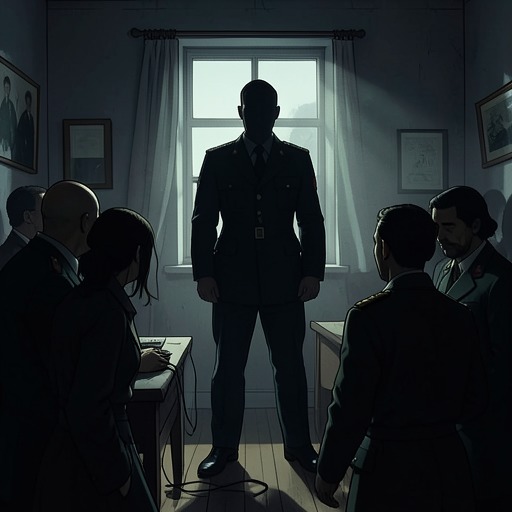
The only person the Allies encounter is a very dark-complexioned man in a silk dressing gown, emerging into a corridor. Asked who he is and what he is doing there, Lazar smiles, identifies himself, and explains that he is doing nothing unusual because his private residence is in the building. His composure offers no account of the missing contents and no documentary trail. The Allies’ entire haul from the embassy is his smile.
Later evidence in the novel sharpens the suspicion that the vanished property included more than furnishings and personal art. Manuel Arroyo Benítez reasons that shipments Guillermo has agreed to supervise may contain art looted from museums and Jewish owners in occupied territories, along with jewels, antiques, and perhaps gold, silver, or foreign currency from the lost Nazi treasury. He recalls that, on 18 July 1947, Clara Stauffer had wanted to introduce the man she knew as Rafael Cuesta Sánchez to a friend called Bam. If the name ended in an “m,” rather than an “n,” the visitor could only have been Lazar, known by that nickname to his intimates.
That identification connects Lazar to the Allied Control Commission’s earlier discovery that he was the only person left in the empty embassy. The Allies suspect he secretly transferred the embassy’s and ambassador’s residence’s treasures to a hiding place they have searched for in vain, together with documents from an archive that has never resurfaced. Spain authorized his repatriation in February 1946 after sustained Allied pressure, but on the day before he was due to board a plane for Germany, he entered the Clínica Ruber with acute appendicitis. The appendix was genuinely removed; his pursuers nevertheless suspected that the operation had provided a way to evade return. Afterward, he disappeared from their view.
Narrative significance
Lazar’s career binds propaganda to access, and access to the quiet movement of people, money, and information. He is effective not merely because he can pay journalists or place material in the press, but because he understands how political influence is sustained through hospitality, professional opportunity, and the feeling of belonging to an inner circle. His work crosses institutional boundaries: the Austrian embassy, Goebbels’s propaganda apparatus, Transocean, the German Embassy in Madrid, Spanish news organizations, and EFE all form parts of a career whose reach extends from European politics into Latin American opinion.
His public role is defined by visibility: the monocle, the formal dinners, the elegant manners, and the confidently managed newspaper pages. His suspected postwar role depends on the opposite condition, the absence of records and possessions that might explain what happened. The contrast culminates in the bare embassy and the dressing-gowned official who remains there, smiling as the victorious Allies search for evidence. In this final image, Lazar’s talent for controlling what others can know becomes indistinguishable from the mystery of what he has removed from view.